The scarf journey
Six stages, about ten minutes, one scarf that becomes yours. The story quotes its sources by name; each flower opens when you learn one true thing about it; the cloth you compose is a printed cloth, the way the object always was.
The journey is online, on your own phone or computer, in English and Ukrainian.
Opens the journey in English or Ukrainian · about ten minutes
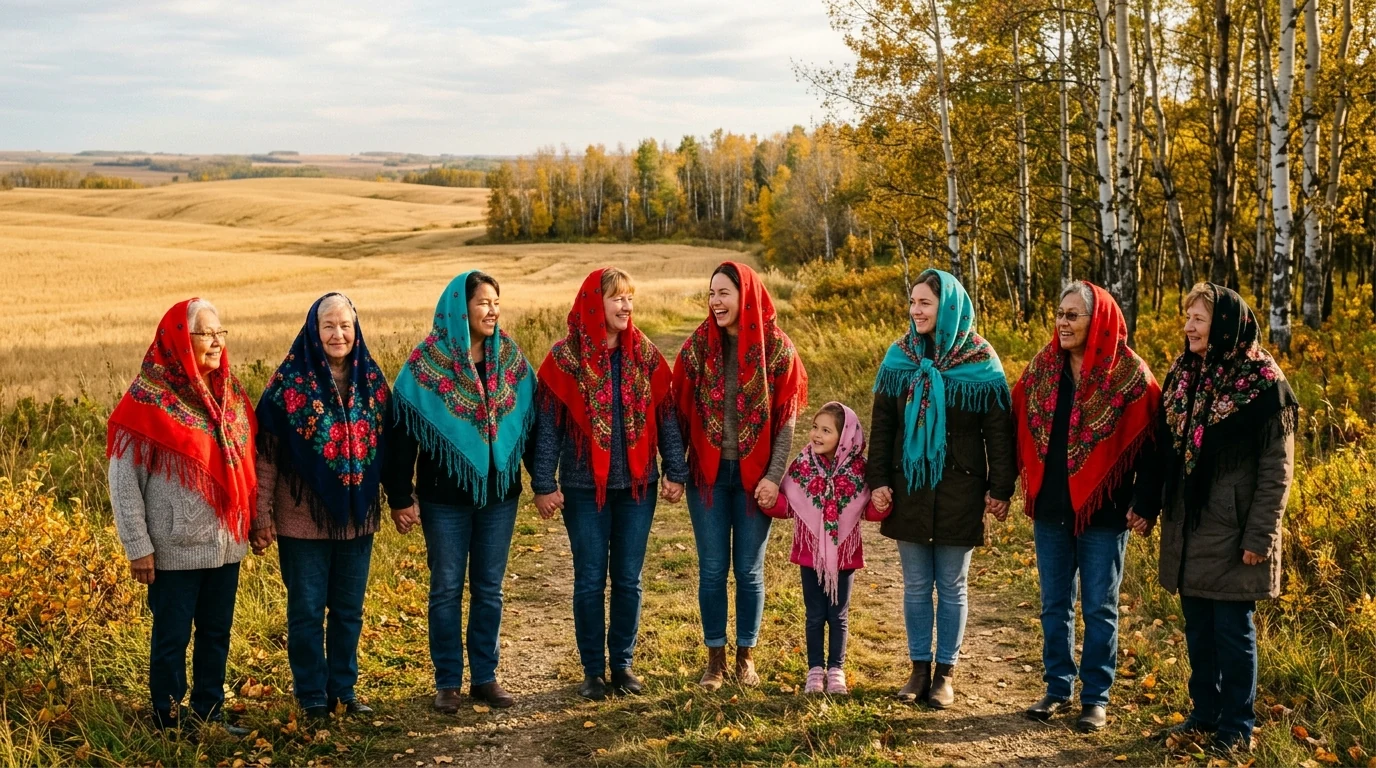
A thin printed cloth with two names — хустка · kokum scarf (Plains Cree kôhkom, “your grandmother”). Nobody has published where the Prairie scarves were made or how they arrived; the story of women trading and gifting them lives in families on both sides, and the one peer-reviewed study records it as memory.
What is documented, what is remembered →The six stages
What happens on the screen, in order.
-
Begin
Where this stands: who made it, what it is, and that nobody has endorsed it — a screen you read before anything else.
-
Story
Four chapters with every source named: the cloth, the flowers that were here first, the land since 1891, the word and the memory.
-
Motifs
Seventeen motifs; three are open, fourteen open when you answer one question from their card.
-
Compose
Arrange your flowers on a printed square: four grounds, three symmetries, three densities, and a design number that rebuilds it exactly.
-
Meaning
Name the scarf, choose three words, write what it means to you — your words, labelled as yours.
-
Your scarf
A keepsake with your name; on a shared tablet a QR code sends the scarf to your phone; an honest path to a printed scarf — no scarf has been printed yet.
Where this stands, September 2026
- Who made it
- A community project started at UAFest. Ukrainian-Canadians made it: the words, the drawings, the code. It is a prototype.
- Status
- No Indigenous community or organization has endorsed or partnered in this project yet. We have asked for community review; it has not begun.
- Voices
- Every Indigenous voice in the story is quoted by name from something that person published. The words you attach to each flower are yours: creative prompts written for this app, and no tradition.
- Printing
- No scarf has been printed. We asked four print shops for prices; one has answered with a price list; we have placed no order.
- Funding
- Nothing submitted, nothing awarded.
- Language
- The journey is in English and Ukrainian. This website is in English, French and Ukrainian.
The story chapters quote published authors by name. Corrections from the communities described here outrank anything we wrote.
Seventeen motifs
Three are open when you arrive — sunflower, kalyna, wild rose. Each of the other fourteen opens when you read its card and answer one question about it. A card says what the plant is, where it grows, who is recorded using it and where we read it; it makes no claim of symbolic or traditional meaning. Where we found no record for a plant, the plant stayed off the scarf.
- Sunflower Helianthus annuus
- Kalyna · highbush cranberry Viburnum opulus
- Wild rose Rosa canina · Rosa woodsii
- Poppy Papaver somniferum
- Saskatoon blossom Amelanchier alnifolia
- Chamomile Matricaria chamomilla
- Apple blossom Malus domestica
- Squash blossom Cucurbita pepo
- St John’s wort Hypericum perforatum
- Flax Linum usitatissimum
- Wheat Triticum aestivum
- Dill Anethum graveolens
- Bilberry · blueberry Vaccinium spp.
- Birch Betula papyrifera
- Linden Tilia cordata
- Moon a symbol
- Your own plant the name of a plant from your own family
Open at the start
How to take it home
On a shared tablet the last screen shows a QR code. Scan it with your own phone: it opens this exact scarf, with the same design number, and you save the keepsake there. Nothing is saved on the tablet. On your own phone the keepsake saves directly.
Want it on cloth? No scarf has been printed yet. Leave one email in the app, or write to info@uafest.ca with your design number in the subject, and we write once — when a printed scarf from your design is real, or to tell you the path closed. One letter, no newsletter.
Write with your design numberSources on this page
- Avery Shtykalo & Gabrielle Legault, Canadian Journal of Indigenous Studies 1(1), 2025 — the object, its names, the exchange as memory — https://doi.org/10.36939/cjis/vol1no1/art38
- itwêwina Plains Cree Dictionary — kôhkom, nôhkom — https://itwewina.altlab.app/word/n%C3%B4hkom/
- Patrick Young, Gabriel Dumont Institute, Virtual Museum of Métis History and Culture — Métis floral beadwork by the 1830s — https://www.metismuseum.ca/media/document.php/00715.BeadworkQuillworkEm.pdf
- Paul Yuzyk, MHS Transactions, 1951–52 — the arrival of 7 September 1891
- Status lines are our own record, dated 12 September 2026. Every claim on this site, and what we withdrew: Our sources, and what we made up