A scarf journey and a sourced archive

Two grandmothers, one cloth.

A thin printed cloth with flowers on a bright ground. Ukrainians call it хустка. Across the Prairies many Cree, Métis and other Indigenous families call it the kokum scarf, from kôhkom, “your grandmother”.

The same cloth runs through shared and divided pasts: families who traded and gave scarves, and the laws and the taking of land that stood between them. We follow what is documented, mark what is only remembered, and keep the Indigenous half of the story open for Indigenous co-authors to write.

No Indigenous community or organization has endorsed or partnered in this project yet.

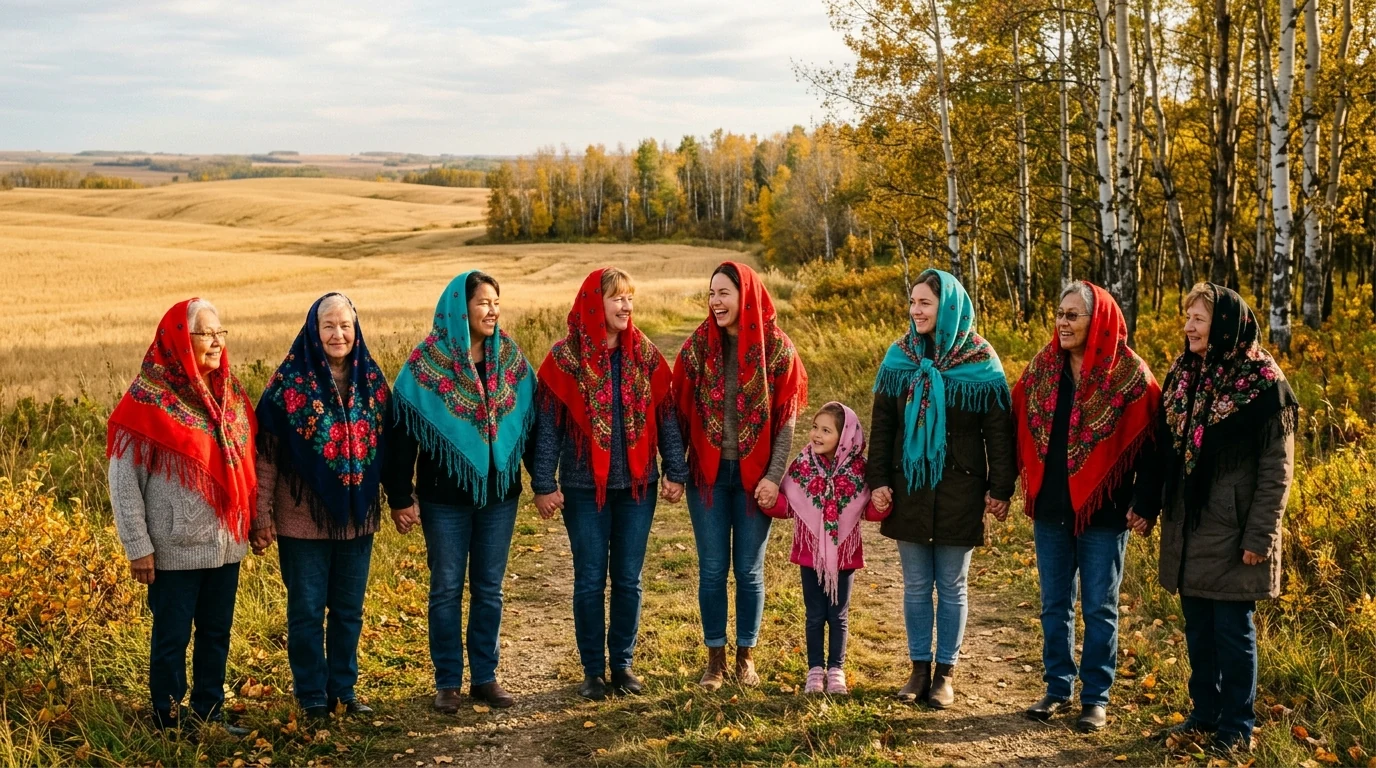
Illustration: women of several generations in bright printed floral headscarves, hand in hand on a field path in autumn.
Illustration: women of several generations in printed floral headscarves on a field path in autumn.
Shared and divided pasts

One cloth, two meanings

Four eras, in order. Each one opens into its own chapter.

The land under it

Ukrainian families received their homesteads because the land had already been taken. Patty Krawec, an Anishinaabe-Ukrainian writer from Lac Seul First Nation: «The land they settled on, the 160 acres they were given on the plains, hadn’t been empty after all. It had been emptied.» Both halves are true at once, and this project tries to hold both. (Rampant Magazine, 14 March 2022.)

Neighbours, and the law between them →
1891–1896

The first winters

Ivan Pylypiw and Wasyl Eleniak sailed on the Oregon, out of Liverpool on 28 August 1891 and into Montreal on 7 September. Seven families and one unmarried youth followed from Nebyliv and Perehinsk in June 1892 and founded the Edna-Star bloc east of Edmonton. A homestead was a 160-acre quarter-section for a ten-dollar filing fee, with three years’ residence and a staged breaking schedule behind it. The first winters were spent in burdei dugouts, pits about a metre deep roofed with rails, grass, sod and earth. (Yuzyk, MHS Transactions 1951–52; Nahachewsky, Ukrainian Dug-Out Dwellings in East Central Alberta, 1985.)

Read the chapter →
Undated

Two names for one cloth

Nobody has published where the Prairie scarves were made or how they arrived. The story of women trading and gifting them lives in families on both sides, and the one peer-reviewed study records it as memory. The florals met florals: naturalistic floral design was established in Métis work at Red River by the 1830s, and Cree makers had adopted Métis floral patterns by the late 1820s. Across the Prairies the same cloth carries a Cree name, from kôhkom — your grandmother. (Shtykalo & Legault, CJIS 1(1) 2025; Gabriel Dumont Institute; itwêwina.)

Read the chapter →
1881–2014

Neighbours, and the law between them

From 1881 a First Nations person in Manitoba, Saskatchewan or Alberta needed an Indian agent’s permit to sell cattle or other animals, grain, hay or root crops; the provision stood until 2014. From 1885 a pass system operated in selected areas, with no basis in law, ignored and openly defied. (Joseph after Carter, Lost Harvests; Barron, Prairie Forum 13:1.)

Read the chapter →
2018–2026

The scarf comes back

Tala Tootoosis ran the #KokumScarfCampaign in Saskatchewan in 2018, four years before the 2022 solidarity wave. After the invasion of February 2022, Indigenous people across Canada and the United States posted portraits of themselves in kokum scarves in solidarity with Ukraine. (CBC, 1 Dec 2018; NBC News, 1 Mar 2022; ICT, 9 Mar 2022.)

Read the chapter →

The six stages

What happens on the screen, in order.

How it works →
  1. Begin

    Where this stands: who made it, what it is, and that nobody has endorsed it — a screen you read before anything else.

  2. Story

    Four chapters with every source named: the cloth, the flowers that were here first, the land since 1891, the word and the memory.

  3. Motifs

    Seventeen motifs; three are open, fourteen open when you answer one question from their card.

  4. Compose

    Arrange your flowers on a printed square: four grounds, three symmetries, three densities, and a design number that rebuilds it exactly.

  5. Meaning

    Name the scarf, choose three words, write what it means to you — your words, labelled as yours.

  6. Your scarf

    A keepsake with your name; on a shared tablet a QR code sends the scarf to your phone; an honest path to a printed scarf — no scarf has been printed yet.

The first step is a cup of tea

Or a thirty-minute call. We show you the journey and ask what sounds wrong. There is nothing to sign and nothing to prepare.