Published · BABA & KOKUM
Buy a kokum scarf from the person or shop that can tell you who drew the print and who is paid for it, ideally an Indigenous maker or an Indigenous-owned shop. Then check two plain things: the fibre content on the label, and the size you need for the way you will wear it. We do not sell scarves. Our partner page says the first print run will go to an Indigenous-owned maker chosen with Indigenous co-authors, and that proceeds will be agreed with them before anything is sold.
If you are shopping for a gift this winter, the questions below come from what the sources on this site support and from what our own partner page promises. Shop names are left out on purpose: makers change, and a list we cannot keep current would date badly by spring.
What you are buying
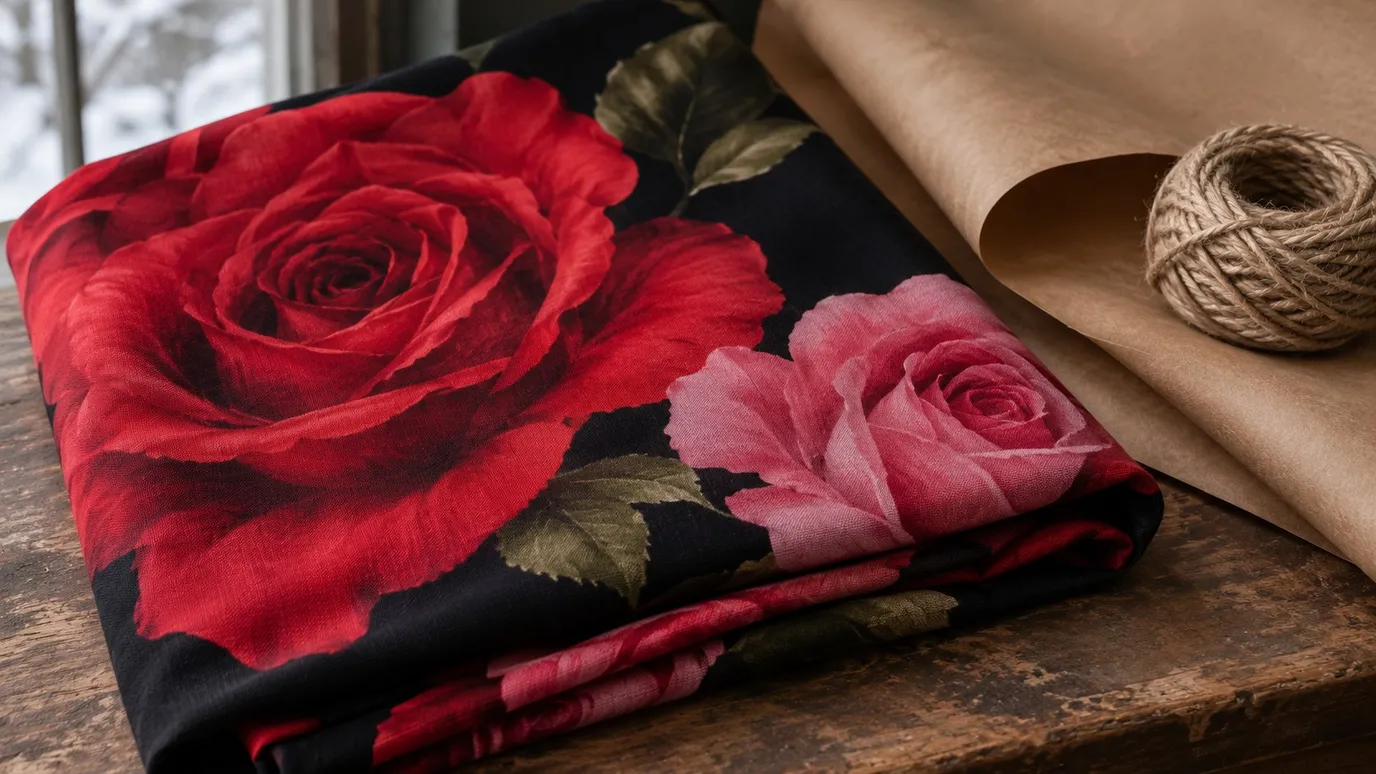
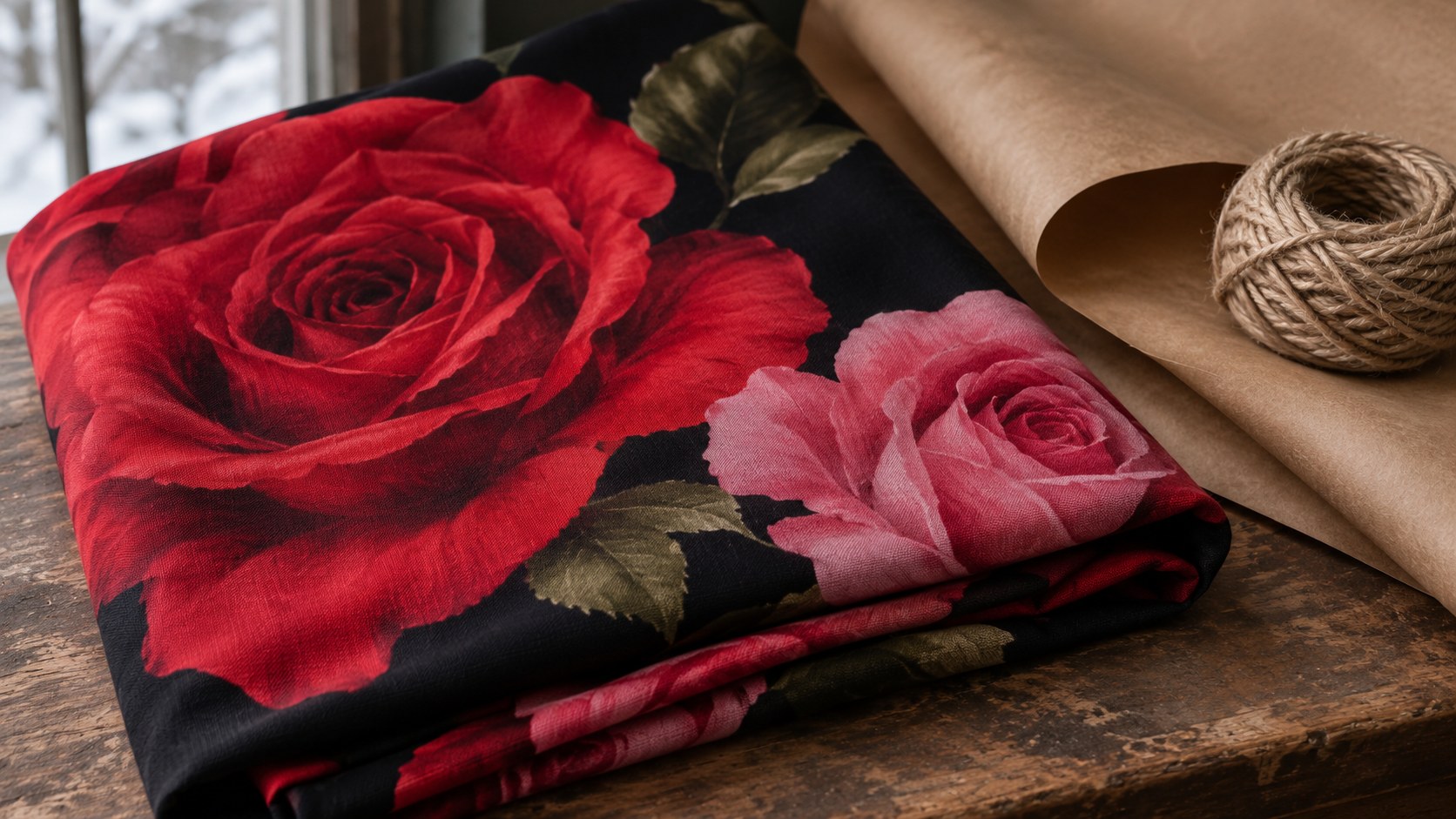
A kokum scarf is a thin, square printed cloth with bright flowers on a coloured ground, worn today by many Indigenous people as regalia, as a shawl, around the wrist or tied over the hair. The name comes from Plains Cree kôhkom, “your grandmother.” Ukrainians know the same kind of factory-printed kerchief as a хустка (khustka). The full story, with a source under each claim, is in our kokum scarf history and meaning guide.
Nobody has published where the Prairie scarves of a century ago were made or by what route they arrived. Be wary of a seller who tells you otherwise on a product tag. In the only peer-reviewed article on the kokum scarf, Patty Krawec says the scarves are “beautiful and they’re accessible,” and that the pattern is “something that looks like our own geography.” (Shtykalo & Legault, Canadian Journal of Indigenous Studies 1(1), 2025, p. 108.) Accessible is a good test for a gift as well: a kokum scarf is meant to be worn.
Who to buy from
The best seller is the one closest to the design. In practice that means, in this order:
- An Indigenous artist selling a print they designed. Markets like the Métis Market that opened Métis Week 2026 in Edmonton are where artists sell their own work.
- An Indigenous-owned shop that names its designers. Look for an “about” page with real people and nations, written by the shop itself.
- A museum or gallery shop that credits the artist on the tag.
- A general retailer only when you can see who designed the print and who made the cloth. A “kokum style” scarf with no name behind it tells you nothing about either.
Online, the same order holds, with one more step: find out where the order ships from. A shop that ships from overseas can still be Indigenous-owned, so ask who designed the print before you trust the word “kokum” in a listing. Read the returns page too, because a scarf bought as a gift may need to be exchanged.
Questions to ask before you pay
| Ask | Why it matters | A good answer sounds like |
|---|---|---|
| Who designed this print? | The design is the part with an author | A named person, and their nation if they share it |
| Who printed and sewed it? | Design and manufacture are often different people | The workshop or the country, said plainly |
| How is the artist paid? | Tells you where your money goes | Royalty, a fee or direct sale, said plainly |
| What is the fibre? | Drape, warmth and washing depend on it | Percentages by fibre, on the label |
| How big is it? | A wrist wrap and a shawl need different sizes | Measurements in centimetres or inches |
For the size, think about how it will be worn. A scarf tied over the hair or worn as a shawl needs a bigger square than one wrapped around the wrist. Ask for the measurements, then hold a tape measure across your own shoulders before you order.
How to read the label in Canada
A scarf sold in Canada is a consumer textile article, and its label has to give two things. The first is fibre content: the generic name of every fibre that makes up 5% or more, with its share as a percentage, in both English and French. The second is the dealer: the company name and mailing address, or a CA Identification Number, which only Canadian manufacturers, processors and finishers can hold. (Competition Bureau Canada, Labelling textile requirements in a nutshell; dealer information.)
A CA number on the label lets you look up the Canadian company behind it. A label with no fibre content at all is a reason to ask the seller before you buy.
Printed scarf, embroidered towel, beaded flower
Gift guides often mix three different objects. A kokum scarf is printed cloth. An embroidered Ukrainian towel or shirt is needlework, and a beaded flower on a bag or moccasin is beadwork, each with its own makers and history. If the person you are buying for loves the flowers, any of the three can be the right gift; just call it by its name. Our page on print and embroidery sets the printed and the stitched flower side by side, with sources.
Before you buy: print one on the porch
If you are not sure which flowers to look for, open the Porch Print Shop. You print a scarf square by square for a guest on the porch, and every flower you unlock opens a herbarium card with one fact and its source. It runs in a browser on a phone or a computer, in English and Ukrainian, and asks for no account.
An Indigenous maker of printed scarves?
Our first print run is meant to come from an Indigenous-owned maker chosen with Indigenous co-authors, with any proceeds agreed with them before anything is sold. If that could be you, write to us. Nothing goes on this site without your written yes.
BABA & KOKUM is a community project started at UAFest. No Indigenous community or organization has partnered in this project yet. We take no commission from any seller, and this guide names none.